

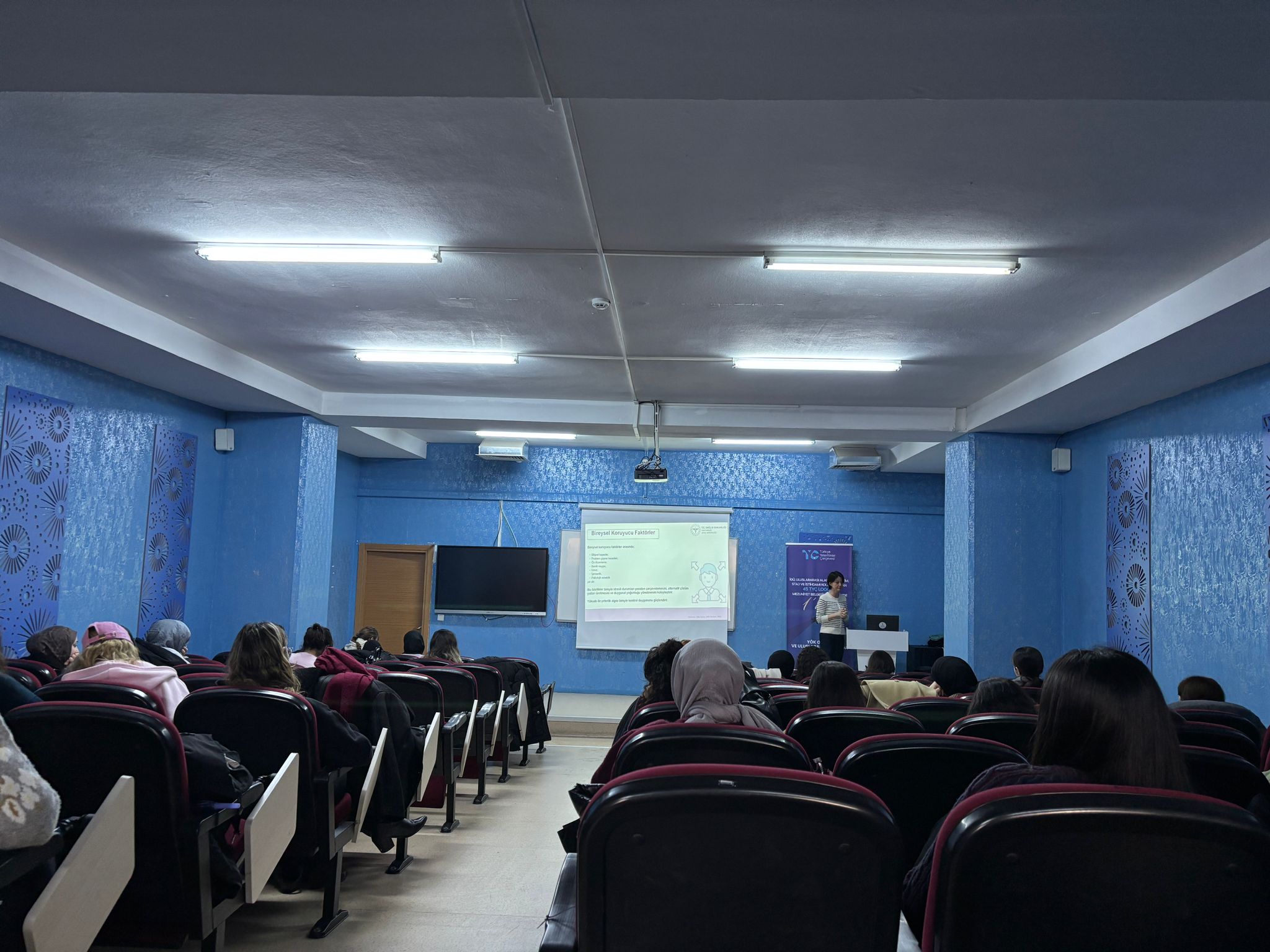
The training program, hosted by Assoc. Prof. Dr. Nurten ELKİN, Faculty Member of the Faculty of Health Sciences at Istanbul Gelişim University and IGU Coordinator for Combating Addiction, was held on 30.03.2026 in two separate sessions between 11:00–12:00 and 14:00–15:00. Within the scope of the “Strengthening Youth Mental Health Program” conducted by the Republic of Türkiye Ministry of Health, General Directorate of Public Health, Psychologist Gül Deniz TUNADURUR and Social Worker Öznur KURT from Beylikdüzü District Health Directorate took part as trainers. At the beginning of the training, Assoc. Prof. Dr. Nurten ELKİN briefly informed the students about the program of the Ministry of Health and its importance, and then gave the floor to the speakers.
The trainers began their speeches by emphasizing psychological resilience and discussed its definition, the conditions required for psychological resilience, and risk factors:
“Psychological resilience is the process by which an individual can maintain psychological functioning in the face of stress, trauma, loss, and chronic adversity, restore disrupted balance, and preserve adaptation capacity. Resilience is not a characteristic limited only to an individual’s personal strength; it is a dynamic adaptation system shaped by the interaction of biological infrastructure, cognitive regulation processes, family relationships, social environment, and cultural context. Resilience is associated not only with the absence of illness but also with maintaining a meaningful and functional life. Current literature emphasizes that resilience is not a fixed personality trait, but a capacity that can change and be developed throughout life. According to the literature, two conditions must coexist in order to speak of psychological resilience. The first condition is that the individual encounters a significant risk or stressor such as trauma, illness, poverty, violence, or loss. The second condition is that despite these risks, the individual can maintain psychosocial functioning or regain disrupted functioning. In other words, resilience is not about never experiencing difficulty, but about maintaining adaptation despite difficulties. The concept of psychological resilience emerged in the 1960s–70s through longitudinal studies conducted in the field of developmental psychopathology. Research has shown that some children growing up under high-risk conditions can adapt without developing psychopathology. These findings led to the emergence of the concept of the ‘invulnerable child.’ However, over time, it was understood that these children were not completely unaffected, but rather possessed certain protective factors. Thus, the focus shifted from ‘invulnerability’ to a dynamic understanding of resilience shaped by the interaction of risk and protective factors. In the current approach, resilience is considered as a process of adaptation that develops and changes within the interaction between the individual and the environment. Resilience is not a fixed trait; it can be learned, supported, and varies depending on conditions. The same individual may show different levels of resilience at different stages of life. Adversities are situations such as life events, trauma, abuse, poverty, chronic illness, family conflict, and migration that threaten an individual’s physical, psychological, or social integrity. The severity, duration, and recurrence of adversity determine the individual’s adaptation capacity. Exposure to chronic and multiple stressors increases the risk of psychopathology. Adaptation, on the other hand, is the individual’s capacity to maintain functionality in life domains. Individual risk factors refer to vulnerability areas arising from the individual’s own characteristics. Temperament traits (high anxiety, impulsivity), low self-esteem, and inadequate problem-solving skills are among these risk factors. Negative cognitive schemas and difficulties in regulating emotions make adaptation to stress more difficult. These factors are not determinative on their own; they operate in interaction with environmental conditions and social support. Because they are modifiable, they constitute an important target area in preventive interventions. Familial risk factors include parental psychopathology, domestic violence, neglect, inadequate care, and attachment problems. A persistently disorganized family environment increases the risk of psychopathology in children and adolescents. Environmental risk factors are elements that develop outside the individual’s control and determine daily living conditions. Poverty, unsafe neighborhoods, social exclusion, and discrimination create continuous sources of stress and weaken psychological resilience. Low education and limited opportunities make it difficult for individuals to develop coping resources. Such risks generally have long-term and cumulative effects. Their impacts should be evaluated together with social support and public services rather than solely individual characteristics. The factors that most protect individuals against stress are social support, problem-solving skills, emotion regulation, positive self-perception, secure attachment, and a sense of meaning in life. The fact that one of two individuals exposed to the same risk copes better can be explained by the following factors:
• Presence of protective factors: strong social relationships, flexible temperament, previous coping experiences, and cognitive flexibility.
• Self-regulation and flexibility: A significant part of the excitement of life comes from overcoming difficulties, seeking change, and stimulation.
Regardless of our coping style, being ‘flexible’ is a very important quality. Being flexible means being able to say that anything can happen in life, never saying ‘never,’ accepting oneself and others with imperfections, being able to endure adverse events, not catastrophizing, being open to new ideas and differences, not being afraid to try, flowing with life, and being able to return to one’s original form even after bending…
Social support networks, social trust, cultural values, and a sense of belonging strengthen an individual’s resilience capacity. Culture shapes how stress is interpreted and the strategies used to cope with it. In collectivist societies, social solidarity plays a protective role, whereas in individualistic societies, autonomy may be more prominent.
Methods to Strengthen Psychological Resilience:
• Increasing emotion regulation and stress management skills,
• Developing problem-solving and flexible thinking skills,
• Strengthening a sense of purpose, hope, and meaning,
• Establishing healthy lifestyle habits (sleep, nutrition, physical activity),
• Social support and secure relationships,
• Creating a supportive climate in school/work environments,
• Psychoeducational programs and group work,
• Not personalizing difficulties,
• Accepting that there are events beyond our control.”
After the presentation, the program concluded with the answering of students’ questions.
“Psychological resilience is the process by which an individual can maintain psychological functioning in the face of stress, trauma, loss, and chronic adversity, restore disrupted balance, and preserve adaptation capacity. Resilience is not a characteristic limited only to an individual’s personal strength; it is a dynamic adaptation system shaped by the interaction of biological infrastructure, cognitive regulation processes, family relationships, social environment, and cultural context. Resilience is associated not only with the absence of illness but also with maintaining a meaningful and functional life. Current literature emphasizes that resilience is not a fixed personality trait, but a capacity that can change and be developed throughout life. According to the literature, two conditions must coexist in order to speak of psychological resilience. The first condition is that the individual encounters a significant risk or stressor such as trauma, illness, poverty, violence, or loss. The second condition is that despite these risks, the individual can maintain psychosocial functioning or regain disrupted functioning. In other words, resilience is not about never experiencing difficulty, but about maintaining adaptation despite difficulties. The concept of psychological resilience emerged in the 1960s–70s through longitudinal studies conducted in the field of developmental psychopathology. Research has shown that some children growing up under high-risk conditions can adapt without developing psychopathology. These findings led to the emergence of the concept of the ‘invulnerable child.’ However, over time, it was understood that these children were not completely unaffected, but rather possessed certain protective factors. Thus, the focus shifted from ‘invulnerability’ to a dynamic understanding of resilience shaped by the interaction of risk and protective factors. In the current approach, resilience is considered as a process of adaptation that develops and changes within the interaction between the individual and the environment. Resilience is not a fixed trait; it can be learned, supported, and varies depending on conditions. The same individual may show different levels of resilience at different stages of life. Adversities are situations such as life events, trauma, abuse, poverty, chronic illness, family conflict, and migration that threaten an individual’s physical, psychological, or social integrity. The severity, duration, and recurrence of adversity determine the individual’s adaptation capacity. Exposure to chronic and multiple stressors increases the risk of psychopathology. Adaptation, on the other hand, is the individual’s capacity to maintain functionality in life domains. Individual risk factors refer to vulnerability areas arising from the individual’s own characteristics. Temperament traits (high anxiety, impulsivity), low self-esteem, and inadequate problem-solving skills are among these risk factors. Negative cognitive schemas and difficulties in regulating emotions make adaptation to stress more difficult. These factors are not determinative on their own; they operate in interaction with environmental conditions and social support. Because they are modifiable, they constitute an important target area in preventive interventions. Familial risk factors include parental psychopathology, domestic violence, neglect, inadequate care, and attachment problems. A persistently disorganized family environment increases the risk of psychopathology in children and adolescents. Environmental risk factors are elements that develop outside the individual’s control and determine daily living conditions. Poverty, unsafe neighborhoods, social exclusion, and discrimination create continuous sources of stress and weaken psychological resilience. Low education and limited opportunities make it difficult for individuals to develop coping resources. Such risks generally have long-term and cumulative effects. Their impacts should be evaluated together with social support and public services rather than solely individual characteristics. The factors that most protect individuals against stress are social support, problem-solving skills, emotion regulation, positive self-perception, secure attachment, and a sense of meaning in life. The fact that one of two individuals exposed to the same risk copes better can be explained by the following factors:
• Presence of protective factors: strong social relationships, flexible temperament, previous coping experiences, and cognitive flexibility.
• Self-regulation and flexibility: A significant part of the excitement of life comes from overcoming difficulties, seeking change, and stimulation.
Regardless of our coping style, being ‘flexible’ is a very important quality. Being flexible means being able to say that anything can happen in life, never saying ‘never,’ accepting oneself and others with imperfections, being able to endure adverse events, not catastrophizing, being open to new ideas and differences, not being afraid to try, flowing with life, and being able to return to one’s original form even after bending…
Social support networks, social trust, cultural values, and a sense of belonging strengthen an individual’s resilience capacity. Culture shapes how stress is interpreted and the strategies used to cope with it. In collectivist societies, social solidarity plays a protective role, whereas in individualistic societies, autonomy may be more prominent.
Methods to Strengthen Psychological Resilience:
• Increasing emotion regulation and stress management skills,
• Developing problem-solving and flexible thinking skills,
• Strengthening a sense of purpose, hope, and meaning,
• Establishing healthy lifestyle habits (sleep, nutrition, physical activity),
• Social support and secure relationships,
• Creating a supportive climate in school/work environments,
• Psychoeducational programs and group work,
• Not personalizing difficulties,
• Accepting that there are events beyond our control.”
After the presentation, the program concluded with the answering of students’ questions.